
About Me

My photo
Grumpy, yet verbose.
Showing posts with label reaction roll. Show all posts

Sunday, December 23, 2018

Moldvay Musings XIII: Reactions

"For every action, there is an equal and opposite reaction."
-Newton's Third Law                           


Sorry, Isaac. Not necessarily in D&D.

Like morale, reactions rolls have also faded from the later editions of the glorious mess that is Dungeons & Dragons. Sure, there are skills and such that allow for things like diplomacy and bluffing, but I am not a fan of too many defined skills in D&D. It's fine in games that were designed from the start for them -Runequest/BRP springs to mind- but they as much a hindrance as a benefit in old-school play (whatever that means). 

Back on topic, the encounter reaction rules in versions like BX are incredibly simple. Other than the Charisma adjustments table, they are one paragraph of text and one 2d6 table of five possible results (B24). The rules simply state that while some monsters will nearly always behave in the same way (e.g. mindless undead attacking), it is possible for some creatures' actions to vary.  

I've covered a bit about hirelings in an earlier post, so I'm mostly sticking to the encounter mechanics here. Suffice to say, the retainer reaction rolls (B21) help add a layer of detail to an integral part of the BX-style game. Adventuring parties were assumed to include meatshields and the like. Uncharismatic PCs, miserly offers of pay, or poor treatment could make life difficult for a party that needs to pad its ranks or flesh out weak spots in its lineup.

As stated in the preceding section on party actions, if they choose to talk, they might influence the monsters' (or NPCs') attitude toward the encounter and, by extension, the PCs. In my games, I interpret "talk" loosely. A common language isn't always required. An offer of food to a predator can be as effective an overture as speaking confidently and calmly to a goblin patrol in their tongue. (Side Note: This can be a case for using alignment languages and making those INT bonus language slots worth something in one's game!)
We didn't deserve you, Steve!

A couple of caveats to consider. One, the DM always has the right to veto making a reaction roll and simply decide how monsters, etc. will act. An elven patrol is unlikely to let the party go after they just burned down the Sacred Oak, no matter how charismatic the PC spokesperson is! 

Two, even if a roll is made, there could be negative modifiers. The goblins mentioned earlier might be fine with avoiding a fight under normal circumstances. However, if the PCs are there to stop their shaman from performing a blood sacrifice that will give them victory over the villagers, the patrol just might be less inclined to believe the party is "just passing through." Even unintelligent creatures can have circumstantial biases. In real life, encountering a bear in the woods will usually not result in an attack (if you aren't stupid about it, that is), but a grizzly sow with cubs can be another matter! Tossing her some iron rations is probably not going to cut it, even for evasion purposes.

I guess what bothers me about this mechanic falling by the wayside is it removed a big incentive for actual roleplay in a dungeon environment, as opposed to just chatting up the tavern wench for -ahem- "rumors." To me, the BX reaction mechanic was an elegant solution that allowed for player agency and a bit of luck.

I confess I don't know much about 5th ed. What little I've played of it didn't seem to lend itself to this, but I could be wrong. 


Friday, December 21, 2018

Moldvay Musings XII: Morale


The morale mechanic has apparently fallen out of favor in later editions of D&D. I could paw through different books and the intertubes to find the exact edition where it went away, but that's not really what I'm interested in talking about. Rather, I'd like to talk a bit about how it is employed in many classic RPGs like B/X and why, in my oh-so-humble opinion, it is a very good thing.

First off, I should mention that the morale rules in Moldvay (B27) are expressly listed as optional. The game can be played without them. In my experience,they add a level of realism and survivability to the game that makes them more than worthwhile. Let's take a quick look at the opening lines of the section:
Any creature in battle may try to run away or surrender. Characters are never forced to do this; a character always reacts in the way the player wishes. NPCs and monsters, however, may decide to run away or surrender.
Two main takeaways to consider here:

1) "Characters react in the way the player wishes." There are things like fear spells and effects (Giant Shrews, anyone?) that can effect a PC, but whether to fight on in the face of dire odds is completely in the hands of the players.

2) "Any creature in battle may try to run away or surrender." This is an element of morale that I don't always remember to apply. I usually just have a creature run away if it fails its roll. That's fine for dumb beasts, but an intelligent creature may throw in the towel (especially is escape looks unlikely).This can lead to fun RP between the victors and the vanquished, not to mention alignment considerations by the players.


Remember how a decent charisma score can be a boon not only when hiring retainers (reaction rolls) but in giving them better morale? Here's a fun one: NPCs could decide to surrender to the bad guys if the PCs are losing a fight (or look like they might lose)! They might even switch sides! Weirdly, a counter-argument for not having all the hirelings just work for the one charismatic PC. If the NPCs are loyal to different PCs, that should mean separate morale rolls, which means it's not all or nothing when checking morale. Some minions might break while others remain. 

I mentioned realism and survivability. It seems perfectly realistic than not every encounter ends up a fight to the death. Sometimes nerves fail. Even a bestial predator may decide the PCs are not such an easy meal and take to its heels. BX gets a rep for being fairly lethal. Using morale in your game means some fights end a little sooner, which means fewer to-hit rolls against the PCs, thus less damage taken and fewer casualties. 


Friday, September 7, 2018

REF (Random Encounter Fun): Stone Giants


Rolling on the wilderness tables (I arbitrarily chose "Mountains"), I got "Humanoid" as result (ho-hum), but the roll on the sub-table yielded "Giant, Stone." NOW we're getting somewhere!


Cook says 1d2 might appear in a random encounter and, lucky PCs, I rolled a 2. The description says they may keep cave bears as guards, but in a moment of mercy I originally decided those would be at the lair, not wandering (even though I did roll and they have 4 of them at home!). I changed my mind, however as I developed the idea for the encounter. But I only added one (see below).

The encounter distance came up as 170 yards (4d6 x 10 yards). A pretty respectable distance but giants are tall and easily seen, plus they would have a good vantage for spotting the party as well.

Stone Giants are Neutral and there's nothing in their description to indicate a natural empathy or antipathy toward people. So a reaction roll is probably in order. Unfortunately, it came up a 4, so the giants are not feeling friendly. The giants can throw stones 300', but that becomes yards in the wilderness, so they would probably lead with that. But rather than get into a specific melee, let's take a look at the encounter and try making sense of it.

The party is travelling through the mountains, yes? It's a random encounter, so they haven't met these giants before. The two groups are nearly two hundred yards apart, so it's not like the PCs could have said something to tick the giants off. What would cause such a hostile reaction? Are the giants being territorial? Did they just wake up grouchy? Or did they just want some target practice?

Maybe it's a case of mistaken identity?

Perhaps the giants had a run in with a different group of puny humans, maybe an NPC party? Giants have good treasure, so maybe, in a "My Cousin Vinny" sort of a twist, some other adventurer types tried to raid the lair for the loot. Maybe they succeeded, maybe they were chased off, but during the fracas all but one of the giants' pet bears was killed! Now the giants (the surviving ones at any rate) are angry. After scouring the mountainside all morning looking for the interlopers -using the bear to try tracking them- what should come stumbling by? A group of murder hobos just strolling along the slopes!

Now this could (likely) end up being a straight out fight to the finish, with neither side knowing the whole story. But imagine for a moment that one of the giants speaks Common and yells something mid-fight like "Now you will pay for what you did!" And the PCs retort with something better than "Huh?"

If the slaughter pauses long enough for a non combat actions to take place, maybe the party passes the bear's sniff test and the giants realize their mistake. Perhaps the giants feel guilty, or maybe they offer the PCs a bounty to hunt down the "killer NPCs." Depending upon the PCs' levels, they might decide staying on the good side of some 9HD monsters isn't the worst idea imaginable.

That sounds like a fun little twist. Or at least a potential side quest. Not to mention that, if they are sloppy in their pursuit, they could make enemies out of the NPCs.  Plot fodder for months!


Tuesday, August 14, 2018

RMA: Blink Dogs


I always think of these as an AD&D creature. Partially because of the quirky 1e monster manual Tom Wham illustration, but mostly because that's what we were playing when I first encountered the creature. They are however, also in the BX rules as well as their nemeses, the displacer beasts.

What is up with that tail?

I think these are an unusual encounter because of their lawful alignment (not generally hostile) and running the mechanics of their short-range teleport ability can be complicated.

Blink Dog (from Cook)
AC: 5
HD: 4*
Move: 120' (40')
Att: 1 bite
Damage: 1d6
No. App.: 1d6 (1d6)
Save: F4
TT: C
AL: L

One thing that jumps out at me from the stats is that these are pretty tough dogs. They're roughly on par with a dire wolf (B44) in terms of raw fighting ability (a bit less damage on the bite). Despite that, they are skittish (low morale). This probably stems from their lawful alignment and the fact that they are "highly intelligent." It's worth noting that  the 1st edition Monster Manual lists them as of "average" INT (human level) and possessing a "fairly complex language consisting of barks, yaps, whines, and growls." (MM10) Whether a DM wants to bring that to his or her BX game is another question, but I personally like the idea of a PC learning the language and having to bark and growl to make themselves understood.

The intelligence level means 1) the dogs can be clever in their tactics, and 2) they may choose to not fight (eg low morale). If you allow for the idea that blink dogs have a language, it's also possible that they could know "PC" languages like Common, Elvish, Lawful, etc. which means parley is possible with good reaction rolls.

Moving on to the blink part of blink dog, these canines can "bamf" in and out during a fight. They do so without error and at random distances (1d4 x 10 feet).

Couldn't write this one without a shout-out to Kurt!

Blinking has two main effects during an encounter. 1) if they have the initiative, the dogs can attack someone and then blink away without allowing for a melee counter attack. 2) the constant shifting of position makes fighting or targeting them very difficult. They also can just "blink out" when/if they decide to flee a fight. They have OK treasure in their lairs, but given that they can teleport away, you might have a hard time tracking them there if randomly encountered.

The exception to their skittishness are displacer beasts. They "always attack" them and they are considered natural enemies. This is less a consideration for typical encounters and more of a delightful bit of flavor that could be mined for plot hooks. I like to imagine that the two creatures' were both initially from some other plane and arrived in the world via some sort of accident or freak occurrence. Both exist partially out of phase with the material world, but it manifests differently for each. Maybe they had some sort of Autobot/Decepticon thing going on. Displacer beasts are semi-intelligent, and they "hate and fear" blink dogs. So the antipathy could be baed upon something more than just competing for space in an ecosystem. Food for thought anyway.


More than meets the eye!

Wednesday, June 13, 2018

REF: Castle Encounters

Castle encounters is an interesting subsection of the wilderness encounter tables. Despite the name, it’s not for encounter within a keep or castle, it’s for when the PCs stumble through the woods into the territory of the local lord and one of their patrols. It’s another example of how misleadingly compact the Moldvay/Cook rules are to include such a nifty bit of detail.

As the description states, “When characters discover a castle in the wilderness they will be unsure of the type of reception they will receive.” [X59] The encounter assumes A) the DM doesn’t have an attitude/reaction planned for the patrol and B) “the party does nothing either to arouse suspicion or inspire trust.”

The nature of the patrol (heavy or medium horse) depends upon the type of ruler (NPC class), but that’s a minor detail. Although I love the fact that it states “Note that the men listed are only part of the castle owner's forces. The rest of the force should include men and might even include special creatures such as trolls, or combinations such as superheroes mounted on griffons.”


I get chills.

The meat of this section are the possible reactions. Rather than the full monster reaction table, there are three basic possibilities: Pursue, Ignore, or Friendly. There is no CHA modifier (these are professionals), though I would probably allow a re-roll if the players showed some good role-playing.

Pursue: This isn’t necessarily a chase (though it could be). It could be a toll charged. Refusal can result in a fight or arrest.

Ignore: Just as it says. They pretty much give the PCs a “Move along.” It’s important to remember the ‘nothing to arouse suspicion’ caveat earlier here. PCs can act and look pretty suspicious sometimes without really trying!

Friendly: An invite of the keep’s hospitality. A fun tidbit: This can be offered by bad guys “for evil purposes” (!) Awesome.

A final note regarding demi-humans mentions “Elves, dwarves, and halflings are not given on this list, as their strongholds are special cases.” and suggests they would avoid contact. Fair enough, but that might vary from setting to setting.

So imagine the scenario of the PCs cutting cross-country, entering the territory of a 13th level wizard’s tower. It’s late afternoon and a patrol of a half dozen heavy horsemen appear. They are not hostile and even suggest the PCs might wish to shelter at the tower for the evening. The magus is always happy for guests. If they accept, maybe they come to the tower to find a bugbear mounted on a manticore is guarding the gate and lets them and the patrol enter without fuss.

Is the wizard evil? Are the PCs in for a really bad time? What would happen if they refused the offer? Maybe the mage is benign and he could even become an ally or resource for the party. All because they took a wrong turn at that gully and went one hex off-course.

Man, I love this game!

Friday, April 13, 2018

The BX setting (part 3)

OK, I am wrapping this up. Seriously!

To finish up my musings about settings for a setting representative of the Basic/Expert game, I wanted to touch on just a few more topics: Resources, Risks, and Rewards.

Resources

For me, and many grumpy old-schoolers, managing your resources is no small part of classic D&D play. Heck, I even created products specifically to make it easier to incorporate into tabletop play. Rules like encumbrance, searching times, movement rates, and light source duration all lead to some real cost/benefit decisions being made: Do we take the time to search every room? How many torches did you bring? Do we hire someone to carry our extra stuff?

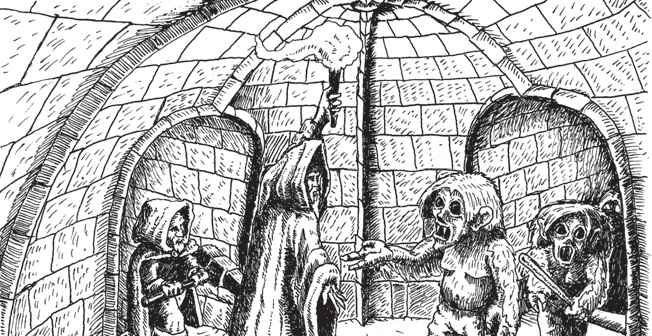
Now all these sound more game mechanics-related than setting, but bear with me. A BX world is a place where not only do decisions like those above matter, they matter because it's a world where dungeon crawls are a relatively common thing. Ancient labyrinthine ruins, extensive subterranean caves, mysterious catacombs, they practically flourish in a BX world. Of course this is true for many other versions of D&D, too. The point is the characters live in a world where someone, at some point, decided that it was a good idea to carve out an underground lair that looked like this.


There are weird, even zany places in a BX world. Maybe they are ancient ruins or a mad wizard's tower, but those that decide to brave those places prepare for mapping long corridors, regular booby traps, hidden passages, and foul monsters lurking around corners. Which brings us to...

Risks

Whether it's claw, sword, or spell, PCs face most of their risks in combat. The BX world is one where monsters are real and your character is going to have to fight for his life at some point, if not many times. A BX world allows for the possibility of a dragon flying over your head as you travel the King's Road or for a hill giant to be walking down a city street! This is a fantasy world. 

That being said, most of these creatures are monsters, not NPC or PC "playable" races (BtB at least). But "monster' does not always equal "enemy." A decent reaction roll and the appropriate language slot can result in parley or even friendly communication. 

Combat can be de-emphasized and other aspects of play can be focussed upon, but by default at least the threat of violence is deeply ingrained into a D&D setting. What can give this a more "BX feel?" Well, BX is a fairly lethal flavor of D&D. PCs tend to be fragile with their lower hit dice and -by the book- 0 hit points being dead. Even mid to high level PCs can be killed fairly easily, and morale rolls can lead to the better part of valor being exercised by monster and hireling alike. Compare that to some of the later versions of the game and you can easily picture a world where life can be a bit cheap and those that live by the sword are likely to pick their battles carefully as well as try to squeeze every advantage out of a situation. And once the battle is over, they will be sure to get as much of the spoils as possible to offset the risks.


Rewards

XP for GP. That brief statement tells me this is a world where its inhabitants gain influence and become more competent by getting as much as they can for as little risk as possible. It's not the slaying of the monster, it's the treasure it was guarding. A BX world is a place where foul humanoids have piles of loot stolen from victims or looted from old castles they now infest. Half-rotted coin pouches lie among the bones in the lairs of terrifying trolls and gigantic spiders. And that axe of antique design wielded by the bugbear chieftain? It has a +2 enchantment on it. 

This is a world of coin-filled coffers and magic swords. Of scrolls containing mystic spells or treasure maps. Of idols with a single ruby eye the size of a golf ball. Of dragon hoards, staves of power and magical rings. The DM may not wish to flood his world with  magic items but in a BX world, such things exist and even leaving it to the random treasure charts the PCs will encounter at least some of them. 

Assuming the characters live long enough, it's also a world where lowly murder-hobos and would-be heroes might accrue enough wealth, fame, and connections to become lords (and ladies) of the land themselves. It's not a place where everything is 100% fixed sociopolitically. Maybe there are wars, or dynastic struggles, or rebellions and invasions. Maybe there are young nations that are still growing. The point is even if your PC started as a turnip farmer, he could one day be a knight in a keep with a fiefdom of his own to rule.

Wrapping Up


What does all this mean? Have I answered the question? Well, no. probably not. But I don't think that it's a question that can be answered definitively. What I do think I've accomplished is to work through some concepts of what I think a setting should or shouldn't have to be a good fit for Moldvay/Cook. 

And maybe it's done a bit that for you, too.