About Me

My photo
Grumpy, yet verbose.

Friday, May 29, 2026

Let’s Talk About Treasure Types (A)

 This is a new series (possibly?) that I am giving a go. We'll see if we get all the way through the list!


In a game like BX, treasure is a key component. Not only as a means for player characters to gain levels (XP for gold), but as a major factor in power scaling. A fighter getting a +1 sword is almost like gaining multiple levels in combat efficacy. A scroll could double a magic user’s spell capacity in a pinch, and so forth. Therefore, balancing the reward vs the risk is an important consideration.

D&D’s designers used the interesting approach of Treasure Types, listed by letter. Chances are if you read this infrequent blog, you already know what these are, but just in case: Each letter type has different odds that different categories of treasure (gold, silver, gems, magic, etc.) are present, and in varying quantities.

What’s fascinating is to look at the logic behind which monsters get which treasure (if any!). I’m sure most of these observations have been made before, but this is just a little walk-through of my own journey down this rabbit hole. So we’ll start at the beginning: Treasure Type A.

Type A loot is listed with an average value of 18K gp. That’s a pretty massive haul. Mind you, these treasure types are listed for lairs, meaning you’ll likely need to deal with larger numbers of the monster to get to it, but if you can pull it off, there’s a tidy profit!

So who gets this kind of treasure? Mostly humans, actually. Some examples are Brigands, Nomads, Dervishes, and Pirates. There are a few non human monsters with this treasure type. Namely, Centaurs, Merman, and Troglodytes. These are also intelligent races that live in groups, so the logic there seems pretty straightforward.

Each of these monsters may have a dozen or more of them in their lair, making a straight up fight likely to be challenging. It’s also worth noting that TT:A gives a decent chance for multiple magic items, as well as a large cache of gems & jewelry. This makes sense, as most of these groups are wandering/transient types that would value portable wealth over piles of heavy coins. These could theoretically be worth over 100K on their own! Though I personally question the die rolls that resulted in a number like that!

Other than the fact that pirates can have a lot of treasure (I already knew that!), what does all this tell me? Well, for one thing, it’s a “civilized” treasure. The “monsters” that have this type would likely value it as money, not just shinies.

Despite that, it’s a treasure type for people that are not entirely civilized. These are travelers, criminals, nomads, or inhumans that still have a culture where things like money could matter. A great deal of the value is highly portable as well. The magic items are likely used by the leader(s), not sitting in a vault or piled somewhere.

Why does this matter? Well, it doesn’t really. Not mechanically. But what it does do for me is help inform the setting. If I know these things about why this particular monster possesses this kind of treasure, it can springboard into ideas that could make the loot more interesting. I could seed plot hooks into what they find. Maybe some of those jewels were taken by the bandits from a powerful noble? Or maybe after defeating the pirates, the only thing the PCs find is one item: a scroll. It is, of course, a Treasure Map to where the rest of the loot is hidden. Where would troglodytes even find 8000 gold coins? Perhaps they slaughtered some dwarves and their clan might pay handsomely to recover the loot and have their kin avenged.

Treasure is such a big part of gameplay in BX-style rulesets that it seems worth taking a moment to think a bit about exactly why that monster has this particular set of potential loot. This can make finding treasure mean so much more to the players than just numbers on their character sheets.

Wednesday, August 6, 2025

Why Magic Users Suck at Fighting

 Rincewind in colour by holepunch on DeviantArt

Often I find myself thinking about common critiques of classic D&D and trying to formulate responses to them. Sometimes it's not so much a defense of a rule, but an explanation of what I think the rules could be describing. Sort of a "Just think about it like this." suggestion. Which leads to the following, which occurred to me this morning as I was walking the dog.
 Magic Users are generally bad at combat for two main reasons. Firstly, they're nerds. They didn't train with swords or condition themselves to wearing and moving in armor during their apprenticeships. They were reading tomes and studying how to get physics to shut up and sit down. Even a MU with a decent Strength score isn't going to be trained in how to use that strength properly in a fight. Sure, if they do manage to connect, they'll hit a bit harder. But a miss is a miss as they say.

The second reason has more to do with the nature of magic in D&D, specifically "Vancian" magic. In Jack Vance's classic stories about The Dying Earth, wizards study and memorize spells to fit their situation or plans. They "hold" these spells in their minds, like a puzzle they are solving mentally. The spell lacks only the final piece to "close the circuit" and release it into the world. Novice wizards are lucky to hold just one simple spell in their minds for any length of time. The more skilled can maintain more than one. There is a reason spellcasters need so much sleep and time to study each day.

The result of these mental gymnastics is that a Magic User is also unable to react as easily in a combat situation. Melee requires total focus, and the wizard's focus is already spread out over several spells.

"Aha!" I hear you say, "but what about Elves? They use swords and wear armor but still can cast spells." Well, that's a fair point. Let's look at elves. 

In most fantasy settings, elves are long-lived. They simply have more time to learn these skills. Second, despite this wider skill set -or because of it- Elves progress slower as a class and can't even cast the highest level spells by the time they reach their XP level limits. Lastly, they're elves. In other words, they are "not human." Their minds are different, both physically and psychically. The way they focus their minds or the limits of their ability to multitask is different as well. In many settings, elves are considered fey (or fey-adjacent). In such cases they are semi-magical beings themselves and their relationship with magic should and is treated differently, while keeping the game mechanics roughly balanced.
Again, I'm not espousing gospel or saying This Is What Gary Intended. I'm just putting ideas out there. This is just a rationale I though might help some folks wrap their heads around things a bit. 


Saturday, November 30, 2024

All That Glitters


Continuing the earlier thoughts about gold in classic D&D…

Over the years, one overall trend in my perspective on playing or running TTRPGS is an increasing deference to the Rules As Written (RAW). That’s not to say I never house rule any more, I do quite often, but it has become more selective and less of a go-to move. There was a time, and this blog contains ample evidence of it, that I would seize upon some game mechanic or suchlike and figure that my decades of experience meant I ‘knew better’ and could fix D&D. Shockingly, it wasn’t quite so simple.

As a result, I have seen more and more concepts and house rules and home-brew charts slip out of my metaphorical gaming Trapper Keeper and out of use when I plan or play a game. A “side effect” of this is watching other folks online work through similar thought processes about the same issues I was trying to “fix.” Often, I watch them arrive at a similar place to mine in real-time, as conversations evolve on chat servers and message-boards with other members of the online groups.

One common bugaboo that seems to come up over & over is coinage. Specifically in two main areas: gold vs silver as the standard denomination, and why coins weigh as much as they do (encumbrance). I’ve toyed with things like the “Silver Standard” (changing over to SP being the default coin) in the past. I’ve since come around to just using gold as in the books. I’ve had a similar progression of ideas regarding coin weight and size. I wanted to talk a bit about my rationales here and I’d like to address the second issue first (as it seems simplest): the matter of encumbrance.

In Basic/Expert D&D, 10 coins weighs a pound (16 oz., or around half a kilo). Now, most of imagining this might say “Whoa there! Those must be some HEFTY discs!” and you wouldn’t be wrong. I believe -and if I ever get the chance to hang out with Zeb Cook again, I hope I remember to ask him- that the numbers were chosen for ease of calculation over any concerns about realism.

That said, I get how it rankles some folks. 100 coins weighing ten pounds seems like it would make shopping around town quite exhausting. For those folks who decide to make the rate things like 20cn/lb or even more, as long as other weights for equipment, etc. are appropriately adjusted, go right ahead.

For myself, I tend more towards things like OSE’s basic encumbrance rules where the weight of most gear is ignored and a character’s movement is determined by how much (if any) armor they are wearing and whether they are carrying treasure. It makes things like equipment choices important, and takes into account the difficulties of hauling loot out of the dungeon without bogging down into every item’s individual weight. Obviously this requires ad hoc rulings on occasion. A recent example in a discussion group centered around carrying a ladder into the dungeon and what it would weigh. My suggestion was to treat it like having treasure in hand (an extra load) without having to get into debates on ‘how heavy is a 10’ wooden ladder’?

The caveat I would make is that D&D coins should be markedly heavier than modern coins, now whether that’s because a modern coins are less dense (the US Quarter hasn’t had silver in it since before I was born), or because the fantasy coins are just bigger, the fact remains if the money is supposed to contain the valuable ores in question, it’s going to be made of dense metals instead of modern alloys. Make them heavy enough that hauling a bunch out of the dungeon is at least a bit of a chore.

The other issue that is frequently brought up “the silver standard” or some variation of it. I should make it clear that I am talking about folks changing D&D’s gold piece default via a house rule, not about separate games with a silver standard baked-in from square one. In a nutshell, this is house ruling that silver is the default currency instead of gold, so prices in the equipment lists are in SP instead of GP. Most, but not all, versions of this house rule also make 1SP=1XP.

Again, I understand the reasoning. I’ve had similar ideas myself. Different people have posited different defenses of the silver standard house rule over the years, but as far as I can see, it boils down to complaints about “realism.” The argument tends to go along the lines of “10 gold coins weighs a pound, that means there are literally HUNDREDS OF POUNDS of gold in that chest. That’s nuts! There isn’t enough gold in the world for there to be so much treasure like that lying around! If there was, then gold would be worthless!” Or words to that effect. Fair enough, I suppose. But let me offer a few points in defense of why I use the gold standard as is in the rules.

Firstly, it’s easier to not change a rule than to change it. It’s how the game was designed, it’s how all the adventures and supplements use it, so it’s less headache for me to just leave it alone.

Secondly, the game is designed around exploring dungeons to find treasure. Getting past the traps and monsters to that chest of loot is literally and figuratively the players’ reward. The game mechanics of the treasure are irrelevant to the emotional satisfaction (aka “Fun”) the players get from their success. One of the ways I can make that better for them is in describing the scene well, and gold is just more evocative of wealth than silver. It’s just cooler looking. Look how ubiquitous it is in popular culture. Pirates’ chests are full of gold! The dragon doesn’t sit on a pile of silver!

Thirdly, Dungeons and Dragons was not created to emulate anything remotely like a real-world economy. Some editions, settings, and supplements have taken whacks at it, but originally no. It’s a fantasy game. Also for what it’s worth, it’s unlikely a fantasy/medieval gold coin is very pure. It could easily be 10K or less. Besides, all money is fake. It’s an agreed upon delusion that lets economies happen, so as long as folks agree that one “gold” coin can buy X amount, then it’s all good.

Lastly, the dragon sitting on the hoard is realistic, but what the coins are made of is too far??

Finally, let me just remind folks I’m talking about the games that I run. Other GMs’ mileage may vary, but for me, chasing after some standard of simulationism just leads to diminishing returns on the enjoyment of the game.

Wednesday, November 27, 2024

A Subdued Reaction


As I mentioned in the previous post, dragon subdual rules are an interesting little nugget buried amid the monster listings which rarely comes up in my games, but after talking about dragons in general, I felt it deserved a closer look.

Essentially, PCs can choose to beat a dragon up instead of killing it. Damaging spells and ranged weapons cannot be used to subdue -though I might allow thrown rocks, but not sling stones or bullets. Rather, blunt weapons like clubs or maces are used. A sword can be turned to hit with the “flat of the blade” for similar results. The battered creature, being intelligent enough to understand that the party could have killed it, but they chose not to. Therefore, to save its skin, the dragon surrenders.

The “subdued” beast doesn’t suddenly feel affection for the PCs. It is a prisoner. It will try to escape or kill its captors if it sees a reasonable chance. By the book, such a creature cannot be kept for any length of time and must be sold off as soon as reasonably possible. Players could see tens of thousands of gold for a live, subdued dragon sale (up to1k/hp). The AD&D (1st edition) rules in the Monster Manual for subduing dragons and how subdual damage works are far more complex (big surprise!) but follow the same general concepts.

So to start with, why have these rules at all? I can’t speak with authority on what the gang in Lake Geneva were thinking, but I’m guessing that some player wanted to try and capture a dragon for one reason or another and a set of rules was worked up to cover the situation. It would seem the DM that came up with this ruling wasn’t wild about a pet dragon sticking with the party, so he stipulated the selling of the creature was necessary. Given that you pretty much have to get up close and in melee with the beast to subdue it, and that your non-lethal damage does NOT reduce how many points of damage their breath weapon does, it seems a pretty fair level of difficulty for the players to pull it off.

So if you can’t keep Ol’ Scaly to ride around like you’re on Pern, and you would have gotten the hoard anyway if you’d just killed it, why go to the trouble? I can think of three possible reasons:

1) The dragon knows something or can do something for the PCs that they don’t know/can’t do themselves.

2) The dragon serves a role in the larger world and killing it might cause downstream effects the PCs wish to avoid, but they still want the loot or to discourage the dragon from doing something. Maybe it was raiding a nearby town’s livestock, but the dragon’s presence keeps other monsters from overrunning the region. In that case, selling it off might not work, but I imagine releasing the creature once the PCs’ goals are met could be a viable option.

3) Number-crunching PCs. Defeating your average, BTB dragon has about 40hp and is worth about 1700-1800xp. An average hoard has a value of 50K. Referees may or may not award full XP for defeating a foe without killing it (I do) or for the gold earned by selling such a beast (again, I would) but selling the subdued dragon turns approximately 50,000gp (and XP) into up to 90,000! Definitely worth considering.

It’s probably fair to say that not every campaign has an economy that supports many “FS: Subdued Dragon. 1000gp/hp OBO” ads, but it IS something that is assumed to exist in your classic BX world, at least potentially. PCs might not be able to turn dragon resale into a sustainable business, but the idea that there’s one rich person out there that has a use for such a thing is not unheard of. Maybe a chaotic wizard has built his tower and wants to stick the dragon down in the dungeon below it as a guardian monster. He’ll send prisoners down for snacks and let it hoard some loot from any intruders it kills. A recently beat up and robbed dragon might actually be cool with an arrangement like that (at least for a time).

For myself, I’m not 100% on-board with the “must be sold” part of the language. While I wouldn’t make a subdued dragon into a “loyal beast” for the party, like a horse or some such (at least not without some powerful magic), I could see a situation where the players might make a deal with the dragon in exchange for letting it go later. Or where the buyer might have the cash, but it turns out he wants the dragon for alchemical ingredients and plans on killing it and cutting it up for parts. Some PCs might balk at such treatment of an intelligent being and want to find another solution. The dragon might be well-motivated to make such a deal to avoid the chopping block, or see this is an excuse to try and break free. There are many interesting situations to be created from such a scenario beyond a payday for the characters.

The PCs might not even be the ones with the dragon! Imagine them running into an NPC party on the road that’s hauling a bunch of dragon treasure back to town with a blue dragon in a cage. What if the NPC party is cool with the dragon being vivisected by some crazy mage as long as they get paid. What if the dragon could speak and begs the PCs for help (Remember Blues are neutral, not chaotic, in BX)? Now THAT could be a really interesting encounter!

I’ve rambled on a fair bit here, so I’ll wrap up. Is the inclusion of subdual rules sort of… weird? Maybe. But to me, it’s a weirdness very consistent with the Swords & Sorcery aspect of BX and fits really well into the assumed nature of BX settings. It’s also a rule that simply is not likely to come up terribly often. Not unless dragons are way more common in your games than mine. Not only do the PCs need to encounter a dragon either as part of a dungeon, randomly, or seeking one out on purpose; then they’d need to decide to forgo most spells and ranged attacks, then they’d need to defeat it with nonlethal damage, and THEN they need to get it someplace with a buyer to sell it to. If the party doesn’t have a buyer lined up ahead of time, what do you do with the dragon while you are asking around town? Granted, the party could realize quite a windfall from this, both in wealth and XP, so be prepared for the fallout from that. Most parties that could pull this off are probably far enough from low levels that it won’t disrupt things TOO much for each of them to gain 15-20K xp and similar amounts of treasure. Frankly, the boost to their reputations might be a bigger deal depending on how the society in your game views such things.

It’s a complicated enough endeavor that I wouldn’t spend a lot of time or energy worrying about the rules being balanced or more detailed or not. Chances are if your players are about to try subduing a dragon, you’ll have some heads up to review the rules and make your choices. For myself, I think the rules as-is are a pretty good springboard for this kind of situation to get introduced into a campaign. If dragons are at all a big deal in your setting, subduing a dragon and the aftermath of it could easily give you fodder for the next several sessions. 


Sunday, November 24, 2024

Dragons in a BX World


The game is called Dungeons and DRAGONS, after all.

Fantasy games and fiction have sort of placed the dragon as the quintessential boss monster. It’s the big fight with the big payoff. Examples abound with Smaug’s hoard, Fafnir in Norse Mythology, countless adventure modules, multiple video games, and so forth.

Dragons also have a reputation for puissance. They are strong, they are tough, they breath death upon their enemies, and they can fly. Some are even spell-casters. Scary stuff, yeah?

So why aren’t dragons tougher in BX?

The biggest, baddest, actual dragon* is the Gold. They have the most HD, best AC, do the most damage, and can always speak and cast spells. They are also the only Lawful dragon, and therefore less likely to be hostile (though it’s certainly still possible one might attack a party).

The truth is, dragons are not the scariest thing out there in a BX setting. If I were a PC, I’d rather face a dragon than several standard monsters that are scarier IMO. Monsters such as: Salamanders (frost and fire), Bronze Golems, some Hydras, Purple Worms, and most of the things that can petrify you or drain levels. So the question becomes why do these creatures have such a reputation? Sure they are formidable, but they are actually not as lethal as most people seem to think.

I think that it boils down to a few things. First is the popular perception developed literally over centuries of stories and legends. Dragons occupy a particular, almost Jungian, place in our cultural psyche. For people who are likely to read this blog, this is even more so, because we are more likely to have read or seen more fantasy fiction and games that reinforce the trope.

The second is a little more to do with the way the game itself is designed. By the book in BX, you can encounter a dragon randomly in most wilderness hexes, albeit not a high chance. Even though they are included in the Basic rules, that has more to do with them being a possible “dungeon encounter,” as that is Moldvay’s focus (as opposed to wilderness in Cook). This means it’s not that unusual for characters to encounter a dragon at relatively low levels (at least when rolling randomly), and for most inexperienced PCs, if it comes to a fight, it won’t likely go well for them. Thus dragons gain an in-world reputation for lethality. They certainly can burninate the peasants’ thatched roof cottages with little trouble.


Which brings me to the breath weapon. Doing your current HP in damage where a Save only halves it? That’s a brutal opening move. Even if the damage goes down as they get hurt, they have that option 3x day, so even a smaller dragon, say an average 6HD white, might dole out 50-60 points of damage to multiple foes over a few rounds. That will wipe out most name level PCs, unless they make their saves (plural) and/or have magical protection (Resist Cold).

Third is intelligence. Dragons are played as smart, cunning predators that can live for centuries. Like intelligent undead (i.e. vampires), they have the time to plan their defenses well. Dragons are rarely without a plan or some sort of defenses in their lair. They will use smart tactics, or even magic, against their foes. This can make them far scarier than a dumb beast with similar stats.

Loot is a big factor in their reputations as well. While it does not directly affect their lethality, dragons’ Treasure Type H is a sweet haul, as it should be. There are other, tougher, creatures out there that have worse loot, so I think the dragon hits the “sweet spot” of maximum reward for a lot, but not impossible amount, of effort. As such, characters are motivated to seek the creatures out and many of them fail.

So what does all this mean for the dragon’s role in a BX setting? Well, this can vary a lot depending on the kind of world you are running, but I see them as sort of like a dying race. They are ancient, but few in number. They are solitary, predatory, and territorial. They crave wealth but rarely spend it. Their thinking is not like a human beings. Their perspective is one of centuries, not years. They are savage in the sense that they are not part of a “civilization.” But they are intelligent and can plan. They can (often) speak and so will sometimes choose to converse instead of fight. While there are things out there bigger and badder than dragons, there is almost no person or creature out there that would face a dragon lightly.

Dragons are generally smart enough to steer clear of heavy populations. It knows it will eventually attract attention. Either because the easiest hunting in populated areas is the livestock, or rumors of its treasure will spread, Any people who do live near a dragon are probably fairly isolated as well. They may see it somewhere between a predator, like a lion or shark, and a local nature spirit, like a river god. It may have been there forever, but rarely involved itself with people. There have been enough encounters to have given it a dangerous reputation, though.

I believe, and this really is just my opinion, that the fact that dragons aren’t actually so much “on paper” speaks to the massive opportunities they present in a campaign. They occupy such an interesting, almost unique, niche in the world that DMs can find a lot of interesting fodder for their games there. Most of the fun happens outside the combat rounds anyway. Even if the PCs just fight and kill the creature, that hoard might lead to a scramble to claim the wealth. Maybe five armies won’t show up for a normal sized hoard, but local bandits, a corrupt Bürgermeister? Who knows? 

In other editions of the game, dragons can be far, FAR more dangerous, even godlike in their powers. There's nothing wrong with that, but I think it's sort of fun that the dragons here are more integrated into the world. They're rare, but known. I like to imagine that it's sort of like certain wildlife in the real world. To someone that lives near the Florida Everglades, seeing a large gator is hardly unheard of, but it's still noteworthy. And if someone from Ohio comes to visit, they'll probably be more amazed when that gator crawls across the grass than the locals, but it's not like they didn't know alligators existed!

 *I’ve written before about “dragon-kin” like sea dragons and dragon turtles. For this post’s purposes, I’m sticking to the ones on page B26: White, Black, Green, Blue, Red, and Gold.


PS: While this isn’t directly related to this rant, I should mention that dragons in BX (and some other editions) can be subdued. This is where the dragon is reduced to zero hit points “non-lethally” and surrenders. I think this deserves its own post, as it is a really wild rule, but the fact that you can theoretically capture a dragon is an interesting facet of their role in BX worlds.


Thursday, July 4, 2024

Moldvay Musings XXII: Experience for Gold

Hello again! Assuming anyone is still out there. With the recent end of our latest Traveller campaign, I’ve stepped away from the gaming table for a spell. Some family matters have made the last several of months distracting, but I’ve recently begun a personal project that’s got me trying to get back into the old-school D&D mindset. Thus, I have thoughts to blog.

There was a recent discussion online regarding OSE (Old School Essentials), the excellent BX re-skinning by Necrotic Gnome. A DM new to the system (I think he had previously run 5e) was asking about alternative experience/leveling methods other than XP for GP.

Several options and house-rules were bandied about. But as I read through them, it reinforced my preference for the as-written method of experience being mostly from treasure found through adventuring. My impulse was to reply to the thread directly, but as I organized my ideas, I realized there was a bit more connected to the subject than I first thought. So I decided to fling them all onto the page here and get them out of my skull.

NB: This got… wordy, so here’s the TL;DR – A character’s XP level or progression is not the ONLY way they can become more powerful within a game-world. Using treasure earned through adventuring as the way to measure their progress as adventurers makes perfect sense in a game like classic D&D.

First of all, when I say I like the XP/GP model, I mean specifically for D&D, especially if there is a focus on dungeon crawling. Other games and systems use completely different methods of advancing characters, and they work great. I wouldn’t try to change Call of Cthulhu over to a level based XP system relying on treasure-hunting.

But why do I like XP/GP for D&D? Firstly, and this is the least of it, it’s the way the game was originally written. My overall game-mastering perspective is typically to change as little as possible in the rules as written unless I find a compelling reason. Also, as I have said before “You can’t ‘Fix’ D&D.” There is a point in the rules-tweaking cycle where one has to ask if it’s still the same game?

The next reason I like XP/GP is simply that it makes sense. If you are playing old-school D&D as I believe it was intended, then your game is a series of risk/reward exercises. When you break into an ancient tomb, most PCs would have profit at least partially on their minds. So if the gold is the reward, what’s the risk? The monsters, the traps, NPC rival parties and bandits. In risk management, the goal is to maximize reward and minimize risk. Making combat attractive by adding making it a bigger source of XP results in risk-seeking, not risk management.

Now XP/GP isn’t perfect. The question often arises of what does a mid-to-high level character DO with all their coin? Not all PCs are interested in building a stronghold, and if you don’t let them buy expensive magic items or similar, they can amass an alarming amount of cash. I’ve written in the past about PC wealth and ways to help them spend it. The truth is this all comes back to the attitude of the players (and the DM). Wealth can be a role-playing challenge. What would you do if you were your PC and came into that money? I know some folks would say “Not go out adventuring again, that’s for sure!” And if it fits your character’s story to retire at that point, who is to stop you?


I would counter that maybe that’s not being the best player that you could be in the sense that you are a member in a group of (hopefully) friends. Leaving the party high and dry as your experienced PC bails on adventuring to open a tavern might annoy the rest of the group.  I usually enjoin players to think of character concepts that include wanting to continue adventuring. Or needing to in order to reach a goal. What you might “settle” for in real life may be VERY different from what your PC would deem enough. We’re playing a game of imagination, we can figure something out that makes sense if we agree on things like basic genres and tropes. If, as a kid, you and your friends went out to play Cops & Robbers, the compact there was there were two main types of people in the game: police and criminals. If one kid then claims he’s Spider-Man and can just web-up all the robbers, that’s a very different game.

I should take a moment to stress that in my games, experience is earned by treasure earned through adventuring. If you invest in a shipping line or marry the old widow and you end up with a million gold pieces, you don’t suddenly shoot up in level. You don’t become a better adventurer by not adventuring. Which is another reason I mislike things like “Story XP.” If the story involves adventure and monsters and such, then building some treasure into that is simple enough. Even if it’s a reward the adventurers are paid by an NPC and not found inside a chest in some dungeon. If the “plot arc” resolves itself without your typical adventuring activities, then it shouldn’t result in your PC leveling up in their adventuring class. But if that’s the case, why wouldn’t everyone just turn full murder-hobo? Because, dear reader, another reason I like XP/GP just fine is that XP doesn’t have to be the only kind of in-game reward.

Did you ever wonder why there was no experience award for magic items in BX and other older editions? Likewise, they have no listed market prices. I believe it’s because magic items are intended as their own rewards. That magic armor doesn’t give you experience points. It gives you a freaking suit of magic armor! Actually, it technically does give you XP by increasing the chances of your survival. There aren’t set prices because magic items are, well, magical. I am not saying that I make it impossible for my players’ PCs to sell or buy magic, but it’s very case by case. Magic items do reward the characters, just not with XP.

Likewise for story goals that don’t include “normal” adventures to accomplish. There should be some reward, but it might not be XP. As I said before, if you thwart the Ice King and save Princess Bubblegum and then she gives you and your party 100K gold pieces, that’s earned by adventuring and 100% grants XP. But what if she names you all Heroes of the Realm and knights you? There’s no cash, and no XP, but that is definitely a reward. Everyone in the kingdom respects you and people seek you out for more quests and hero-work. You probably attract the notice of the court and access to all sorts of rumors and favors. You aren’t suddenly name-level, but your fortunes have definitely improved.


"Personal Goals" XP is no different. You’re finally getting the chance to avenge your brother’s death? Awesome! Let’s have a great scene where you get to confront the guy and have it out with nine-fingered man. When you win, maybe there’s loot, maybe not. Maybe achieving the goal contains an in-game reward like with the princess. Perhaps your vengeance clears the family name, and now you can restore your title? To me, personal character goals are meant primarily as RP opportunities and fodder for the DM to tailor the adventures to the player's interests, Not an XP source.

If achieving that kind of goal doesn’t mean anything to the player because “it’s just RP” then maybe he needs better goals, or maybe these types of RP goals aren’t for him. Next time maybe he can say “My lifelong goal is to kill a dragon and take its hoard!” This is why I often have powerful NPC lords and ladies who aren’t necessarily name-level adventurers. They’re influence isn’t acquired by how many hit points they have. In less civilized places, “tougher” nobles (with levels) may be more common, though.

Remember, these rules aren’t intended to cover everything, so you need to decide how you want to handle the things that aren’t spelled out. Characters can do an awful lot in the game without worrying about what level they are, especially in a game as flexible and rules-light as BX. So before worrying too much about changing things like XP for GP, look a little deeper and ask how it can work for your games instead of how it can’t.

Tuesday, March 21, 2023

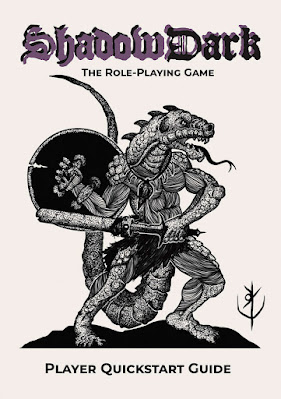
ShadowDark RPG: Marrying the Old and New

 I recently stumbled across a Kickstarter for a new OSR product from a fellow longtime Garycon attendee. Kelsey Dionne has been a respected writer of 5e adventures for a while now, and has her gaming roots from growing up in southern WI, even meeting Gary at Gencon when it was in Milwaukee and playing with Gary-adjacent types in her youth like Jim Mishler. Her keen eye for design and brevity makes her work a very easy read.

Now she has released ShadowDark, her take on the 5e rules streamlined and simplified for old-school style play, and it is fairly impressive. The quickstart rules are free to download on her website, the Arcane Library, and her Kickstarter fairly blew up upon release and is closing in on the $1M mark. 

There are a lot of interviews, reviews, and let's plays out there online, so I won't try to rehash all that here. Suffice it to say I backed it and I am looking forward to getting my copy of the full "Core" rules after the campaign ends. I will probably use the rules for my next fantasy campaign as well. At least a one-shot or two.

At time of writing there is still over a week left in the Kickstarter, so take a look around at the quickstart rules and toss a few bucks in the hat if it looks interesting to you.


Thursday, February 16, 2023

RMA: Gargoyles


This was going to be an REF, but I was a little surprised to see that I hadn't done an RMA for Gargoyles. Perhaps because they aren't that uncommon as a monster. Since it turns out there is a lot to these rocky ruffians, I decided an RMA was more appropriate.

(from Moldvay)
Gargoyles

AC: 5
HD: 4
Move: 90' (30')
    Fly: 150' (50')
Att: 4 (2 claws/1 bite/ 1 horn)
Damage: 1d3 ea./1d6/1d4
No. App: 1d6 (2d4)
Save: F8
Morale: 11
TT: C
AL: C

So, a few things leap out here. First off, FOUR attacks! None of them are exactly dragon's breath in terms of damage, but still! Secondly, it saves as an EIGHTH level fighter despite only having four hit dice. That's a resilient creature! Gargoyles also have a very high Morale. These guys aren't cutting and running too much.

Moving on, there are a couple items from the description that are worth mentioning. Magic or magic weapons are required to hit them. So right there that ups the ante for an encounter. Remember, these are Basic monsters, not Expert. The description actually states "The DM is advised to use gargoyles only if the player characters have at least one magical weapon."

Secondly, they are immune to sleep and charm magics. This limits lower level spell casters somewhat, as Sleep  is a perennial favorite option vs monsters of 4HD or less. 

Third, 
"Gargoyles are very cunning and at least semi-intelligent. They will attack nearly anything that approaches them." 
Which meshes nicely with their high Morale and Chaotic alignment. These are vicious things! I wouldn't play them as highly intelligent or capable of long-term planning, but simple ambushes or clever combat tactics would be reasonable.

Couple all that with the fact that you are usually running into at least a couple of them in any given encounter makes it that much dicier.

Oh, and they can fly.

Treasure type is C; Which is respectable enough, but no one is retiring on the loot. 

While it isn't specifically stated, I would argue that their stony skin would lead to plenty of potential surprise situations.

DMs looking to make a memorable encounter should be taking all this into account. Low level parties running across a nest of these things should know they've been in a fight! If it were a planned encounter or set piece, I might be nice and drop hints about their presence. Perhaps even rumors in town about "flying demons" spotted in the hills or what have you. 

For players, I heartily hope that there is a magic weapon or two in your arsenal. Since Gargoyles appear on the Level 3 wandering monsters, I'll say your party should probably average out to 3rd level. that means you should hopefully have a 2nd level spell or two at your disposal. Hold Person  should work (they are roughly humanoid) on the clerical side. Magic-users might look to Web  or Phantasmal Force.  As always, Light to blind foes is a good choice, too! Even Levitate to partially counter their aerial advantage could be useful. And, of course, there's always running away!

Tuesday, February 14, 2023

RMA: Mermen

 RMA: Mermen


I've held forth in the past about aquatic encounters, but the majority of water creatures in BX are monstrous or mythical animals: Things like giant fish or water termites. There are very few sentient sea creatures apart from dragon-kin or fairy types. The one notable exception to this in BX is the Merman.

Mermen are not fae. They are a mortal race of half-man, half-fish that live in undersea communities. Usually coastal waters. 

(YOU know, Unda the... ocean!)


Mermen (which includes mermaids, I presume) are quite rare as a random encounter, only occurring as a single entry on one wilderness encounter sub-sub-table (Swimmers: Ocean). Typically found in small hunting parties averaging a dozen or so. But we'll get to that. First, the stats:


(from Cook)

Mermen

AC: 6

HD: 1-4

Move: 120'(40')

Att: 1

Damage: 1d6 or by weapon

# App: 0 (1-20)

Save: F1

Morale: 8

TT: A

AL: N


Okay! So first off, not terribly imposing. The rank and file merman has ONE whole hit die, so an average of 4-5 hit points. No real armor protection (though swimming in armor is its own problem), and a pretty skittish morale. This paints a picture of a fairly unintimidating foe. But one must remember that the threat from mermen isn't their toughness, it's the environment!

A player character in the water should be at a major disadvantage. There are not a lot of rules in the books about how to deal with swimming/underwater PCs. Some options for a DM may include things like slowed movement, reduced attack and defense (maybe no DEX adjustment for AC) and wearing heavy armor and/or carrying a lot of gear could mean sinking instead of swimming. Not to mention the challenge of breathing if you go under the waves.

Mermen face none of these issues. If a PC has to strip off his armor and shield, then once they dive in find that their mobility and fighting ability is reduced might revisit just how "dangerous" that 1HD fish-man with a trident really is!

Another issue to keep in mind is that Mermen may keep trained sea beasts as guard animals. DMs should feel free to get creative with this. Maybe it's a shark, maybe a whale, or it could be a giant squid!

Mermen parties often have a 2HD leader type with them. Larger groups might have a 4HD chieftain type. These individuals are probably not tipping the balance of a fight where the fact that there are dozens of mermen already in the mix, but it is worth keeping note of. 

I think the real value of mermen in a campaign or setting isn't as a foe, but as an exotic race that the characters can meet and interact with. I'm not saying they need to be friendly, but as they are Neutral and described in hunter-gatherer terms, treating them like a "native tribe" might not be a bad angle to take. Perhaps they could be enticed to guide the PCs to that nasty dragon turtle's lair. Or maybe they can retrieve something from a sunken ship for a price?


Sunday, February 12, 2023

RSA: Protections from Evil

Neither of these are hardly an uncommon spell, but they do seem to generate a fair bit of confusion from time to time. I don’t pretend to be the final word on interpreting B/X D&D, but it is a game I spend a fair bit of time pondering.


Depending on how you count things, there are two to four spells in this category: 

The “personal” vs the 10’ radius and the Clerical vs MU/Elf versions. For the purposes of this Random 

Spell(s) Assessment, we’ll just be (mostly*) looking at the former.

Starting off with the first one of these spells that players are likely to get their hands on, there is the 

classic: Protection from Evil.


(from Moldvay)

Cleric 1/MU 1

Protection from Evil Range: 0 (caster only)

Duration: 12 turns


This spell circles the cleric with a magic barrier. This barrier will

move with the caster. The spell serves as some protection from

"evil" attacks (attacks by monsters of some alignment other than

the cleric's alignment) by adding 1 to the clerics' saving throws, and

subtracting 1 from the "to hit" die roll of these opponents. The

spell will also keep out hand-to-hand attacks from enchanted

(summoned or created) monsters (such as living statues), but not

missile fire attacks from these creatures (see COMBAT). The cleric

may break this protection by attacking the monster in hand-to-hand

combat, but still gains the bonus "to hit" and saves.


*Both MU versions are nearly identical to the clerical versions, so there’s no need to list both descriptions here. The one big change is that the duration for the MU 1st level spell is half that of the clerical: Six turns instead of twelve. I guess those arcane types aren’t getting a divine assist. Everything else is the same.

There is a fair bit to unpack in this description, so let’s dig in, shall we?

In essence, the spell creates a sort of force field around the cast that blocks or limits attacks by “evil” creatures. Since this is BX, there is no “Evil” alignment, just Law, Chaos, and Neutrality. As in the “Detect Evil” spell, evil is defined as a differing alignment having an “evil” intent (malice, etc.). So a Neutral Elf would be protected from lawful or chaotic beings wishing him harm, etc. 


The first effects listed are pretty straightforward. The caster gets a buff to saves and the baddies get a penalty to attacks (+1/-1). The next part is interesting, though. 


“The spell will also keep out hand-to-hand attacks from enchanted (summoned or created) monsters (such as living statues), but not missile fire attacks from these creatures (see COMBAT).”


This point is probably where I see the most confusion from people: Notice that the stuff about differing alignment is no longer in play here? That chaotic chieftain is getting a -1 to hit you, but he can absolutely try to smash you in the face with his battleaxe. That Bone Golem? Not so much. This is an important distinction. I’ve seen games where this wasn’t clear to the group and a lot of confusion arose about how exactly the baddies could do anything to the caster after this measly 1st level spell was in effect. 

The next thing to remember is that the caster cannot engage in melee combat with the warded monster without breaking the effect. It doesn’t say anything about missile fire, though. Also, the +1/-1 is still going even if the force field is gone. 

The area of effect version is pretty much the same, except it can protect more than one person at a time. It’s also the only way to put the effect on anyone else (both spells are centered on the caster, no other target is valid as written). 


(from Cook)

Cleric 4/MU 3

Protection from Evil 10' Radius Range: 0'

Duration: 12 turns

This spell circles the caster with a magical barrier that will protect

all friendly creatures within 10' of the cleric. This barrier will move

with the cleric. The spell serves as some protection from "evil"

attacks (attacks by monsters of an alignment other than the

caster's) by adding 1 to the caster's saving throw and subtracting 1

from evil opponents' "to hit" roll. This spell will also keep out

melee attacks from enchanted monsters (such as elementals) but

not missile or magical attacks from these creatures. Enchanted

monsters can melee if any of the protected creatures attempt to

attack them with hand-to-hand combat.


(Once again, the MU version is weaker in that it’s a higher level spell than for clerics. Otherwise, no differences.) The new takeaways from here are that multiple people are protected, but only if they stay close to the cleric, and that if anyone even tried melee with the warded monster(s), they can ignore the force field effect in general (“...if ANY of the protected creatures ATTEMPT to attack them with hand-to-hand combat). This means not only that INT 6 fighter could negate that protection with a swing and a miss, he dispels the field for *everyone*. Again though, missile fire is fine for some reason. I guess it’s a look don’t touch kind of thing?

Now, there is some ambiguity regarding the nature of the 10’ radius field. Part of the text seems to indicate that it simply creates a protective field for all the people in the radius, other parts make it sound like it could be used to block a corridor or similar. Personally I’m inclined to the latter, as a 3rd-4th level spell should have a little oomph, IMO. Also the idea that one person attempting melee dispels the effect for all makes it sound like one big field, not multiple personal ones. Fun tidbit: Remember that the alignments you are protected from are determined by the caster’s alignment, not each individual friendly getting the effects. So if a lawful cleric casts it on the party, it won’t grant penalties or bonuses vs. lawful for that neutral thief.

The duration for both of these spells are obviously applicable over more than a single combat. However, given how easily the “force field” can be dispelled, it seems that the +1/-1 is the more durable benefit. Smart timing could grant those receiving the spell’s benefits with a nice little modifier as they move into an area where they expect to be butting heads with folks of other alignments. Entering Area K in the Caves of Chaos would be a great example of when to use it!

Tuesday, August 2, 2022

Giving up the Reins

 Well, the Traveller campaign has continued on with a player taking over as GM and my taking a seat on the player's side of the screen, running an NPC the party had met before. It's working all right overall as I had not read much ahead in the campaign materials, so I don't have spoilers.

The difficulty is in my letting go of "running" the game I'm in. I'm usually the GM and --for good or ill-- I have a particular style. The new GM's style is not radically different, but it's his own as well. I fear I sometimes may chime in with comments on rules or mechanics when I should just be quiet and play. 

On the other hand, one of the reasons I normally GM and not play in our little group is that a couple of the players can, well, be a lot. One is very competitive and dominates a lot of the conversation, making it hard to be heard sometimes without just constantly interrupting. The other favors "storytelling" over rules and die rolls, so he's happier when we don't bother looking up a rule and either A) handwaving the whole thing or B) just letting the GM make an ad hoc ruling and move on. I have no beef with either style, but when I run, I usually only handwave or wing it when the actual rule doesn't exist or is not easily found. 

Both of these players push back when I cite rules, but as GM, I have more of say in how we proceed than as a player. The friction between our styles is more annoying when I am just a player at the table with them. I know that sounds a little petty, but when most sessions consist of getting fellow players talking over and interrupting you when you're trying to describe your character's actions or grumbling when you point out a relevant mechanic in the book, the fun level drops.

I know this is more in my headspace than in their actions, but it's just something that I'll need to process. Otherwise it may be time for a break. Game group dynamics are always interesting to navigate. What's strange is that it can actually vary from one campaign to the next. A group of people can play together just fine for one game system, then be utterly derailed when playing another. I'm not sure what the alchemy is there, but it seems a real thing. 


Thursday, April 14, 2022

Death of the Campaign

 Over the last several months of running Traveller, I've started to notice a pattern in my gaming habits that conflicts with a long-held assumption I've had about styles of gaming and my own preferences. It's forced me to take a serious look at what I want and get out of this hobby.

As a fan of old-school games and things like classic D&D, I've often been a staunch defender of the whole long-term process of characters leveling up over time and getting really enmeshed in an extended campaign. The time it takes to get from 1st to "Name" level being essential to really making the PCs part of the world and for the players to get invested in the setting and what's happening there. There's no substitute for "putting in the work" as they say. It's not that I disagree with this now, but I believe I am at a point in my gaming style, as well as of an age, where my priorities are shifting somewhat.

Lately, I find that I am far more likely to experience burn-out on campaigns that last for months (or longer). This is especially when I GM, but has happened as a player, too. I realize that by some grognardian standards, a 6-12 month campaign is hardly "extended," but when you factor in all the games over the years that have crashed and burned after only 1-2 sessions, I think sustaining one for the better part of a year or more is certainly at the longer end of the curve.

When I went on my game-purchasing spree last year, I originally had the idea of getting at least one published campaign for each system. While Runequest lacks a full campaign (presently), it does have several compilations of scenarios. The thinking was to reduce the workload for me to run the different games and have enough for players to do for a good long while in each game.

The reality has been a little different. While I count myself lucky that my group has really been enjoying Traveller and have gotten engaged with the setting and the campaign, I'm struggling as GM to maintain the energy to prep and run it, even with published materials. My enthusiasm for the campaign has waned over the months and I fear I'm going to need a real break from it soon, which, as experienced gamers know, often means that it will never get picked back up again. Because of this, I've been trying to push through,hoping to regain some momentum. Sadly, that seems to not be happening.

So where does this leave me? Well, for one thing, I've learned something about myself as a GM and a gamer, so that's good. (I guess?) Secondly, I know I will need to make the call about the current campaign at some point, and third, I should focus on shorter, more episodic games where there are frequent "stopping points" to let one wrap up and have some closure before moving on. We had a moment like that in the Traveller campaign right before we shifted gears into the Drinax campaign. Perhaps I should have taken it. Perhaps the open-ended, long term campaign is not for me any more.

Live and Learn.

Thursday, April 7, 2022

Garycon XIV: A Tale of Two Cons

 So Garycon finished up a little over a week ago and I have thoughts.


TL;DR: Not my favorite year of attending. There were issues, not all of which were the convention's fault. But the con seems to be moving in directions I'm not a fan of.

The verbose version:

Due to some issues at the hotel, some rooms that were being renovated were not ready in time for the convention. As a result, several of us were bumped out of the main facility to alternate lodgings at Timber Ridge, the Grand's 2nd hotel on the property which is their waterpark location. The accommodations were fine, but it was not walking distance and one needed to drive or grab the shuttle. To be fair, the shuttle staff were prompt and polite, but it was an added hassle to get to and from one's room. As I said, this was not the event's fault, it was the hotel's. Nevertheless, instead of a room with two queen beds, we ended up with one king and a sofa-bed (guess which one was mine).

Day One (Thu): I started off with running a couple Traveller sessions to earn my GM badge. Both went well, but left me pretty wiped out. So much so I ended up bowing out of my evening game that I was going to play in. 

Day Two (Fri): My early game was canceled by the GM (who ended up unable to attend), later in the day I got to play the sci-fi horror game Mothership. I backed the new edition on Kickstarter so getting some actual at-table time in the system was nice. I spent a little while in the exhibit hall and picked up one or two little things for my kids. 

Something I noticed about myself at this con was that, being an early riser, I was running out of stamina by early evening. Some of that is no doubt due to being socially distant and virtual for the last couple of years. I had slept poorly on the sofa-bed the night before, so I bowed out of another game (minis wargame) as it was supposed to run until midnight. 

Day Three (Sat.): I played an early Cthulhu game run by the excellent "You Too Can Cthulhu" group. Seriously, if you are at a con where they are, sign up for one of their games. Top Notch! Because I really wanted to try the BBQ place at the Timber Ridge, I went back to the room and found Empire Strikes Back on TV to watch as I ate brisket.

Day Four (Sunday): I played a great little game of Star Frontiers. Afterwards, my friend I was rooming with and I had some lunch then headed back to Milwaukee and the airport and home.

So! The good? The games I played in were all pretty fun, both my GM-ing sessions went well, and I got to see some folks I almost never get a chance to talk to outside of Garycon.

The bad? I realized that I don't like playing all day and well into the evenings for multiple days in a row. And given the expense of flying, car rental, and hotel, it makes little sense for me to go for less than the full convention, which means it's harder to justify going. In past years, my reasoning had been that it's the only con I travel to in any given year, so the cost and effort were easier to accept.

This year? Well, that brings us to the "Two Cons" issue I alluded to in the title. 

Garycon has changed a lot over the last several years. It's grown significantly in size, resulting in the venue change, and become more tiered, with different level badges costing up to $1000 each! These features aren't really new, but have been affecting the experience for a while, so I felt they deserved mention. Higher tiered badges increase access and give priority for event registration. This seems fair enough, but it also leads the staff to focus a lot of their efforts on these VIP guests as opposed to the overall con experience for the majority of attendees.

Secondly, it seems that the pandemic has accelerated the rise of virtual gaming, whether it's Virtual Table Top platforms like Roll20 and Foundry, or people watching others stream their games via Twitch, etc. "Shows" like Critical Role and many others have become a big part of the current tabletop gaming scene. It would appear that the powers that be behind Garycon have decided to make an earnest effort to woo some of these groups to making Garycon a definite part of their own "brands." I don't have anything against streamers, whether it's a publisher using the platform to promote their games or gamers making their own content, it's all fine to me. An unfortunate effect of the convention focusing so much effort on currying favor with the streamers is that the original, old-school population of attendees seems to have been getting de-emphasized more and more. There's not something super-specific I can point to and "There! That's it!" but I was not alone in expressing feelings along these lines at the con.

All this being said, I have to say that while Garycon is still a fun time, I think I'll be bowing out of it for the foreseeable future for reasons that are as much my own issues as with how I feel the con is being presented nowadays.


Tuesday, April 5, 2022

This is Free Trader Beowulf. Mayday...


As a gamer of “a certain age,” I grew up as several now-iconic games were just coming on the scene, following the trail mostly blazed by TSR and D&D. Games like Tunnels & Trolls, Runequest, Call of Cthulhu, and Traveller. Mind you, this isn’t necessarily chronologically or historically 100% accurate. Theses are just the non-TSR games that I first started becoming aware of and interested in.


As I mentioned in the previous post, I’m currently running a Traveller campaign using the most recent edition of the game: Mongoose Publishing’s 2nd edition (“MgT2e”). There have been many versions of the game over the decades, published by various companies. Starting WAY back in 1977 with Game Designers’ Workshop’s “Little Black Books.”


My group of friends, being deep in the throes of the original trilogy Star Wars films and reruns of classic Star Trek, were ripe fodder for a game of spaceships and laser guns. I estimate we got a hold of a set of the books circa 1982. Sadly, we never really succeeded in getting a Traveller game off the ground. Oh sure, we ran through wild and wacky (at the time) character generation system, rolling up character after character. But we never managed to sustain a campaign or even play through a full adventure. For whatever reason -a lack of clarity in the text, our youth, or a lack of information on gameplay in a pre-internet age- it just never fully clicked with us. After a time, we abandoned it and returned to fantasy and 1st edition AD&D and a smattering of Runequest.


Fast forward to the Year That Shall Not Be Named. Virtual gaming (in my case, Roll20) had taken the front seat. After a B/X Keep on the Borderlands game that I hastily launched because we were all going out of our collective tree from a lack of gaming, we shifted to another member of the group running some Savage Worlds, giving me a break from the GM chair.


As I mentioned in the previous post, it was around this time that I acquired the latest versions of several games in an effort to A) occupy myself with the reading of them and B) take a look at where some classic titles were at today vs. when they first came on the market. One of these was Traveller.


“Science fiction” is one of those terms that can cover a LOT of different things. Whether it’s pulp, gritty, grimdark, space opera, hard sci-fi or alternate history (to name a few). The best way I can describe Traveller’s brand of sci-fi is “Space Opera with a Hard Sci-Fi Vibe.” This definition is not always received well by some Traveller fans, who relish in all the fiddly rules and stats which make the game feel more realistic than it is. Yet, despite all the different types of ships, drives, technological equipment, star maps, and so forth, the game has the characters flying around in ships at faster-than-light speeds, equipped with artificial gravity and inertial dampers. Alien races and futuristic gear abound, and humanity covers a significant portion of the known part of the galaxy in its third version of an interstellar empire. I don’t say this as a dig against the game, but I wanted to clarify that many of the game’s conceits venture into “Clarketech” territory and it’s good to keep that in mind. Whereas in a fantasy game, one might explain some phenomena through “lost magic” or “the gods”, Traveller often just declares “FTL travel is a standard thing. Don’t worry too much about how it works.” And I’m fine with that. There are always those folks online who love to pick at things trying to devise the best technobabble so as to explain it, but I find that largely unnecessary. Still, it can be hard to steer 100% clear of THE LORE.


Traveller is right up there with the big boys like Star Wars or 40K for extensive lore in a science fiction universe. Decades of books, adventures, articles, and maps provide a wide array of races, ships, locations, historical events, and technology. It’s a massive library, and one that can easily trap you in a rabbit hole of chasing down sources for your game if you let it. For myself, I tend to use game lore as more suggestion than canon and that philosophy has helped me avoid getting stuck in several GM-ing situations over the years. But enough about the history, now on to some actual observations of gameplay.


I’m not going to break down every single section of the rules. This isn’t a comprehensive review. But here are a few highlights. Traveller uses a d6 based system where the core mechanic is simply 2d6+modifiers vs. a default success threshold of 8. All rolls are d6 or the occasional d3. This is a simple system but it works well. Rolling two dice helps reduce the extremes of a single die’s results and the “bell curve” makes most rolls fairly likely to succeed. The chance of failure might be increased (or decreased) through higher thresholds due to things like complexity or haste. Likewise, MgT2e utilizing “Boon” and “Bane” dice (advantage and disadvantage) to represent difficult circumstances or a lucky break.


Character creation is done by starting your character at 18 and rolling on various educational and career path tables. You may attend university or enter a military academy. Or maybe you just enlist in one of the military branches. Perhaps instead you wish to remain a civilian and be a merchant or a scholar. There are many choices. Each “term” of four years calls for a couple different rolls. Gone are the days where characters can die during generation (technically it’s possible, just highly unlikely), but you can still suffer hardships and injuries. Most characters will probably hold multiple careers before “mustering out.” Many PCs are in the late 30s or 40s before beginning actual play. Unlike a leveled game like D&D, your PC has most of his skills at the start of play. While you can train during downtime (often travel), you are already largely who and what you’re going to be by the time the campaign proper begins.


Combat in Traveller is dangerous. There’s no ever-growing pool of hit points that represents some abstract level of durability. Damage is removed directly from your physical scores (Strength, Endurance, and Dexterity). Drop to zero in two scores? KO. All three? Dead. In play, combat goes fairly quickly.


Spaceship combat is more like the submarine duel in the movie The Hunt for Red October than a Star Wars X-Wing/Tie Fighter battle. Each crew member has a job and a time within the combat round to perform their role. Rounds last six minutes to reflect the immense distances two ships can be at and still fight each other. There are rules for dogfights, generally between smaller craft, but I haven’t had the opportunity to run those (yet).


While styles of play can take nearly any shape, one of the default campaign styles in Traveller is the “Tramp Freighter.” This is the small ship a la Firefly, taking jobs and hauling small cargoes in order to pay their expenses and keep flying. Often a party’s ship comes with a mortgage, and paying that monthly note is a major motivation. The book provides extensive rules for ship operations, trade goods, and taking on passengers.


Another common campaign style is more “Travellers for hire.” Often, one of the PCs may have received a Scout ship (somewhat smaller than the typical “Free Trader” merchant vessel) and the party uses this to hop around the stars, looking for adventure. The scout ships have the advantage of being given to retiring scout character on sort of a long-term loan. There’s no monthly payments, other than maintenance, but the Scout Service may give you an errand to run now and then (Adventure Hook, anyone?).


Okay, that whole discussion got a lot longer than I’d planned. Moving on.


I think it’s pretty obvious from all I’ve rambled here that I’ve been enjoying the game. That’s not to say the game is perfect, however. Most of my criticisms of Traveller aren’t actually about the system. One issue is that so much material is spread over so many source, that players and GMs can feel like they are always one book away from having the information they need. While it’s perfectly possible to play with only the core book, there is SO MUCH addition material published that I suspect few groups do.


Another issue, which has mostly to do with Mongoose the company, is that their proofing/editorial process is, well, frankly terrible. The books are often riddled with typos, botched formatting, and unclear wording. They have been making some strides in this area lately, but be sure to check online for errata when you pick up a book or module from them.


(Time to start wrapping this long ramble up.)


Speaking of online, I can heartily recommend a couple of internet resources for the game that any new player or GM can benefit from. One is the Traveller Discord. It’s a great place to discuss the game, get advice, and ask questions about the game. Another is Seth Skorkowsky’s YouTube channel. He has posted many reviews of Traveller products and has a video series with terrific overview of the current rules set.


Currently, my group is in the middle(ish) of a large published campaign called The Pirates of Drinax. Whether we finish the entire story or not is never certain in gaming. What I do feel confident about is that one way or another, Traveller has earned a spot in our group’s game systems rotation for the foreseeable future.