About Me

My photo
Grumpy, yet verbose.
Showing posts with label halflings. Show all posts

Monday, March 18, 2019

Moldvay Musings XV: I Do Declare!


In an earlier post, I touched on situations that require "pre-declaring" actions in BX. That is to say, before initiative is rolled. This is an interesting artifact of older D&D, as I do not think it is used much in "modern" RPGs. Honestly, we've hardly used it ourselves in my group and I don't even recall using it back in the day. Maybe as my beard grays my gray matter is getting a bit tired.

There are a couple of reasons I think this idea has fallen out of favor. For one, it feels a bit more like a legacy mechanic from D&D's wargame roots than something that was consciously added to the early game; kind of like the whole idea of phases to one's actions (Melee, Ranged, etc.). Newer editions by contrast simply tell the player how much of which kinds of actions they can complete on their turn.

The second reason is that pre-declaring can feel like it is making it harder for players to react tactically in an encounter. If I already declared I was casting Bless, then does that mean I can't switch to Cure Light Wounds when I see our fighter get wounded?

These are valid concerns and they do affect the nature of game play, but before dismissing them out of hand, let's look at some of the benefits of this rule.

  1. What's good for the goose. Enemy/NPC/Monster spell casters should need to declare as well. Perhaps as a DM you don't want to tell the party exactly which spell is being flung at them, but the PCs should at least be able to see that the pesky goblin shaman is starting to chant and wave his arms around. This lets the characters A) know who the enemy spell casters are, and B) plan accordingly.
  2. Spell interruption as a tactic. It's true that would royally suck as a low level magic user if your only spell of the day got fizzled because some kobold scored one lousy point of damage from a sling stone. Of course, as mentioned in the first point, that means the PCs can do the same thing to the bad guys (assuming the initiative die is behaving). This can give weaker PCs the opportunity to have a greater effect on the combat, especially if they have a good DEX or other initiative bonuses (like halflings). Also, it gives the aforementioned MU that's tapped out on spells something to do: Just chuck a dagger at any enemy casters and Presto! Old School Counterspell! This also gives players a chance to do something about that incoming Fireball before they're stuck saving for half damage. 
  3. Making magic more than artillery. If your spell casters are vulnerable in this way, it makes the successful use of any spell more useful. When you look at the spell lists in BX, not that many spells are really designed for use in the middle of the fight. Even with a very generous interpretation of what constitutes a "combat" spell (eg healing magic, protection spells, etc.), it only works out to approximately 50%. If a magic-user or cleric's spells aren't as "useful" in a fight, then it gives the players (and the DM) the opportunity to explore some of the other cool magical stuff these characters can do. (For ideas, might I recommend perusing the series of Random Spell Assessments on this very blog!). This also plays into what I've described as a more BX feel to magic, with a more distinctive "flavor" to magic and spell casting.
Personally, I could see going either way with this rule (ignoring or implementing). On the one hand, I know that players generally are loathe to be limited by arbitrary mechanics, but on the other, I do think that this could bring an interesting wrinkle to the game. Some house rules I might consider if I were to try it could include things like: 
  • An ability check (WIS for clerics, INT for MU/Elves) to retain the failed spell. ie it fails, but you don't forget the spell for the day.
  • Letting PCs or monsters shield their side's spell caster to grant them an AC/cover bonus until the spell goes off.

Wednesday, October 31, 2018

Moldvay Musings X: We have liftoff!

I've talked about flying in D&D before, but I wanted to briefly touch upon a nugget of wisdom in Cook that I recently re-read.

In the section on Traveling by Air (X20), it actually gives guidelines for how big (in HD) a creature needs to be to pick up or carry a person. This is useful not only for transport, but for whether a monster can snatch up a PC and carry him off into the air. For example, 3+ HD is required to lift a halfling or smaller. Therefore, technically, a cockatrice could carry a halfling or gnome off. Weird!

This information is incredibly handy, IMO, as it gives me as a DM a quick reference to decide about the tactics of aerial encounters, which can be complex enough as it is. For example, my group recently fought some harpies. While there were no hobbit-sized PCs or NPCs, it would have been nice to know ahead of time that they could have been carried off. (The idea of a charmed halfling just holding out his arms and being flown to the nest for devouring makes me laugh.)


Saturday, April 21, 2018

Endgame, part 6: Elves and Dwarves aka Tree-huggers and Stumpies

I put the last two demi-humans together to wrap this up and because the rules aren't very elaborate with either of them. Like the halfling, elves and dwarves have level limits in BX, meaning there is a point at which (BtB) they aren't really gaining much mechanically from adventuring.

Side Note:

I know this is one of the complaints against race as class, and I don't want to get to deeply into that here, but I would mention a couple of things I've observed over the years. First off, I've rarely (if ever) played or run in a classic D&D game where characters who started at 1st managed to run up against their level caps, even 14th for humans. Second, it's my belief that by the time characters reach those levels, a few more hit points or incrementally better THACO or another spell slot just isn't going to be that crucial. Hopefully PCs involved in the end game at that point are focussed more on the roleplay aspects of being commanders and high priests, etc.

Not to mention that when elves and dwarves hit their cap around 600K XP, the humans are all at about 11-13th anyway. Even if the demi-humans don't level up again and keep adventuring while the wizard is trying for another 400K or so, they'd still be seeing HUGE gains in terms of treasure (coin and magic) during that time.

End of tangent.

Dwarves


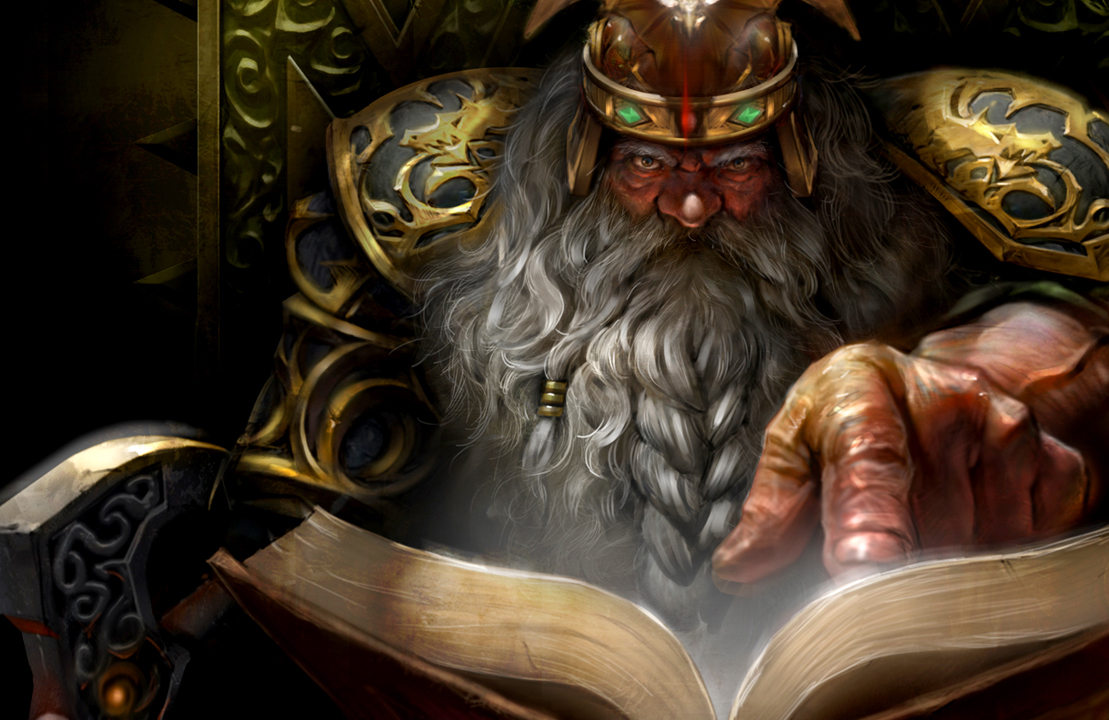
The Dwarf Lord follows a very similar model to the fighter's. He builds a stronghold and protects it. At 270K xp to reach 9th, the dwarf should have acquired enough loot for constructing at least along the Tarnskeep level of complexity.  He attracts members of various clans to his territory. There is a lot of leeway given to the DM in how these clans are organized; be it by bloodlines, trades, homelands, or what have you. In keeping with the stereotype, dwarf holds are largely underground and often in mountains or hills. Dwarves will only hire or retain dwarf soldiers, but can hire other races as specialists, etc. One bit on X7 that intrigues me as plot-fodder says: 
"There will be many different clans of dwarves, each gathered under the protection of a Dwarven Lord, but usually only members of the same clan will live together. Dwarven clans are generally friendly with each other and may join forces in times of need, such as when there is a war of natural disaster."
(emphasis mine) 

So the implication is that the clans don't necessarily get along. That's not to say that there is open warfare in the tunnels, but perhaps rivalries or petty feuds? Dwarves are known to hold grudges, after all. 
In some worlds, they have a book full of them!

The "may join forces" line leaves the door open to the idea that they may not. A good leader would need to herd those bearded cats in times of crisis, and that could make for some fun diplomacy sessions.


Elves


Elves can become lords of their lands at 9th level, which takes them 400K XP to reach. This puts them later than everyone except, interestingly, Magic-Users. The assumed stereotype has these sylvan elves creating a base of operations in some spot of great nature beauty and seclusion. An interesting conceit to balance the cost to the PC is that the efforts of beautification (elaborate woodcarving, landscaping, statuary, or what-not) means that even of the elf-hold is not made of great stone blocks, it costs just as much. Like the dwarves, I find the default assumption of demi-humans retreating from human lands and being somewhat insular a definite, though not exclusive, trait of a BX setting. Like the dwarves, the elf lord attracts other elves to his hold, and only hire elven soldiers. 

Elves have the interesting twist that they protect the creatures of the forest around them and, in turn, all the critters are friendly toward them. These animals can even bear messages to and from the elf lord. (!) Does this mean he can talk to these animals innately? Or does he give them a little scroll to carry a la "Game of Thrones" ravens? I say it's up to the DM, but personally, I'd let him speak to them and they can make themselves understood to the recipients via the elf lord's bond with them and his magical nature. 

(I don't know why I went all Rankin-Bass on this post!)

What a wonderful plot device for low level PCs to be at a village and have a fox come out of the woods to deliver a warning from the local NPC elf lord about some imminent threat!

Speaking of magical natures, I should also mention that as a 10th level spell-caster, like the magic-user, the elf lord-wizard is theoretically capable of spell research and magic item creation. So in addition to his duties as a leader among his people he can also play mad wizard in his laboratory, adding to his arcane powers.

Friday, April 20, 2018

Endgame, part 5: Halfings, aka "There's a new Sheriff in Town!"

Down, down to Hobbiton. You go, my lad!

Halflings are an odd one in BX. I've already espoused their general kickassery as adventurers. Their name level/end game scenario is quite different from the human classes', and only slightly less so compared to other demi-humans. A lot of this can probably be chalked up to the Professor's influence on the class' conceptualization. The LOTR/Hobbit overtones are quite strong. Some later TSR products, like "The Five Shires", offer some different takes on halflings, but we're dealing with straight BX for now.

Since the halfling XP chart caps out at 8th, they reach name level ("Sheriff") before anyone else (120K). As Sheriff, they don't get troops or apprentices. If they build a stronghold, they get "a whole community of halflings." Numbers aren't specified, and I assume are at DM's discretion, but it's interesting that the halfling gets by default what fighters need to entice to their lands. It should also be noted that technically, a halfling doesn't need to wait until eighth level. X7 specifically states he can set up a shire "any time a halfling has enough money."

There isn't any overt mention of clearing a hex or getting a title from the local rulers, but since halflings "prefer pleasant communities in fair countrysides," it seems unlikely that such prime real estate would be unclaimed in any civilized territories. Again, JRRT's idea of hobbits having a secluded nature is coming through here.

In terms of gameplay. I suppose a halfling sheriff would get taxes and could hire mercenaries to protect his borders (bounders), but he isn't really set up to do a lot high level adventuring. Unlike the human classes, he isn't going to progress any further (not in BtB BX, at any rate).


I do see some interesting roleplay opportunities when it comes to things like trade and diplomacy. A fertile land producing goods and commodities, which a powerful character protecting its interests could influence a lot of things in the wider world. Assuming you break with Tolkien's isolationist model enough to have the halflings get involved in such matters.

Thursday, April 12, 2018

The BX setting (part 2)

Races

Soldiering on, one of the ways that a BX setting is not like a typical swords & sorcery world is the presence of "non-monstrous" demihumans.

These guys

S&S tends to be fairly human-centric. With nonhumans relegated to the monstrous or degenerate. While it's not fair to say that classic D&D's default is somehow less fantasy-laden than more modern versions, I think that's its style of fantasy ends to be more of the 'grounded reality with a fantastical layer,' as opposed to 'full-on mix of fantastical elements where the "real" world is almost gone from view.' There is a spectrum here to be sure, and any system has representative settings from various points along the line. But to me BX leans to a pseudo-medieval with magical elements world, and that includes things like elves and such. That being said, the idea of level limits and race-as-class could indicate a world where demihumans that follow the path of the PCs are outliers among their kind and outsiders among the humans. But that's just one interpretation.

Magic

Typical BX settings also stray from many swords & sorcery tropes with magic being far more common and 'stable.' Predictable effects and organization of set spells is a mainstay of nearly all flavors of D&D, as opposed to things like spells using blood-soaked rituals and spells only being found in long-lost tomes. Also wizards in those worlds are typically quite rare and often in league with multiple foul demons or similar.


BX is hardly unique in D&D with settings that include things like player character spellcasters, magic schools, court wizards, as well as town clerics that can cast healing magics up to -and including- raising the dead. This aspect puts it more in line with 'high fantasy' settings. Where BX varies from most other editions is while BX magic isn't terribly rare as a rule, it is relatively limited. 

BX magic-users get 72 standard spells, 6 levels at 12 spells each. They don't even see a 6th level spell slot until after name level (11th). Elves don't even get a 6th level spell by the book, being capped at 10th. Compare that to 1st edition AD&D, with 194 spells spread out (unevenly) over NINE spell levels. Clerics fare similarly, with BX clerics getting 34 spells over 5 levels  vs. AD&D's 76 over 7. That doesn't even take into account the druid and illusionist lists. Not to mention starting clerics aren't even spellcasters yet!

Now, don't get me wrong. I'm not saying AD&D (or similar) is 'broken' by too many spells, but I do think it changes the tone of the game somewhat. It's still definitely Dungeons & Dragons, but I do feel that BX's more streamlined list does contribute to part of the game's feel, and -by extension- to the feel of a BX world.

(to be continued in Part 3)