About Me

My photo
Grumpy, yet verbose.
Showing posts with label bear. Show all posts

Sunday, December 23, 2018

Moldvay Musings XIII: Reactions

"For every action, there is an equal and opposite reaction."
-Newton's Third Law                           


Sorry, Isaac. Not necessarily in D&D.

Like morale, reactions rolls have also faded from the later editions of the glorious mess that is Dungeons & Dragons. Sure, there are skills and such that allow for things like diplomacy and bluffing, but I am not a fan of too many defined skills in D&D. It's fine in games that were designed from the start for them -Runequest/BRP springs to mind- but they as much a hindrance as a benefit in old-school play (whatever that means). 

Back on topic, the encounter reaction rules in versions like BX are incredibly simple. Other than the Charisma adjustments table, they are one paragraph of text and one 2d6 table of five possible results (B24). The rules simply state that while some monsters will nearly always behave in the same way (e.g. mindless undead attacking), it is possible for some creatures' actions to vary.  

I've covered a bit about hirelings in an earlier post, so I'm mostly sticking to the encounter mechanics here. Suffice to say, the retainer reaction rolls (B21) help add a layer of detail to an integral part of the BX-style game. Adventuring parties were assumed to include meatshields and the like. Uncharismatic PCs, miserly offers of pay, or poor treatment could make life difficult for a party that needs to pad its ranks or flesh out weak spots in its lineup.

As stated in the preceding section on party actions, if they choose to talk, they might influence the monsters' (or NPCs') attitude toward the encounter and, by extension, the PCs. In my games, I interpret "talk" loosely. A common language isn't always required. An offer of food to a predator can be as effective an overture as speaking confidently and calmly to a goblin patrol in their tongue. (Side Note: This can be a case for using alignment languages and making those INT bonus language slots worth something in one's game!)
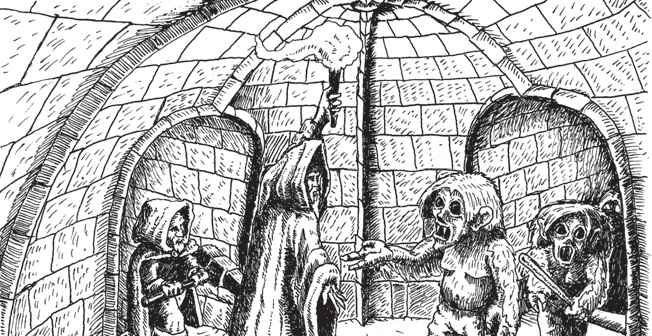
We didn't deserve you, Steve!

A couple of caveats to consider. One, the DM always has the right to veto making a reaction roll and simply decide how monsters, etc. will act. An elven patrol is unlikely to let the party go after they just burned down the Sacred Oak, no matter how charismatic the PC spokesperson is! 

Two, even if a roll is made, there could be negative modifiers. The goblins mentioned earlier might be fine with avoiding a fight under normal circumstances. However, if the PCs are there to stop their shaman from performing a blood sacrifice that will give them victory over the villagers, the patrol just might be less inclined to believe the party is "just passing through." Even unintelligent creatures can have circumstantial biases. In real life, encountering a bear in the woods will usually not result in an attack (if you aren't stupid about it, that is), but a grizzly sow with cubs can be another matter! Tossing her some iron rations is probably not going to cut it, even for evasion purposes.

I guess what bothers me about this mechanic falling by the wayside is it removed a big incentive for actual roleplay in a dungeon environment, as opposed to just chatting up the tavern wench for -ahem- "rumors." To me, the BX reaction mechanic was an elegant solution that allowed for player agency and a bit of luck.

I confess I don't know much about 5th ed. What little I've played of it didn't seem to lend itself to this, but I could be wrong. 


Friday, October 5, 2018

RMA: Lycanthropes (part 5, werebears)


Now we come to the final entry among the were-critters: the Werebear. I've written about normal bears before. The were version is a fair bit tougher, stat-wise. In fact, they're closer to cave bears.

Werebears (from Moldvay):

AC: 2 (8 for humans)
HD: 6*
Move: 120' (40')
Att: 2 claws/1 bite
Dmg: 2d4/2d4/2d8
No. App: 1d4 (1d4)
Save: F6
Morale: 10
AL: N

If provoked, these creatures are pretty dangerous. Their armor and morale are quite respectable. In addition to their normal 3 attacks, they can hug for an additional 2d8 damage if they hit with both claws. That's potentially 4d4 + 4d8 damage to a victim in a single round! That's an average of 28 points of damage. Even if that doesn't kill a foe, it could easily set them up for lycanthropic infection; even a name level fighter (9HD) only has an average of approximately 30-40 hit points.

As formidable as they are on the lycanthrope ladder, werebears in D&D are interesting for being the only ones listed as potentially friendly. They are also described as "very intelligent, even in animal form." This is taking a pretty far step from the raging beast within stereotype of things like "Wolfman" movies, etc. In fact, I wouldn't be surprised if a lot of the inspiration for this particular -ahem- "skin changer" came from someplace else.

hmmmm. What could it be?

To be fair, there is a rich tradition of shape-changing bears in Native American folklore, too. I can't help but think that Beorn is at least part of this monster's origin, though.

Saturday, September 2, 2017

RMA: Of Cave Bears and Clans


Let's talk cave bear:


No, not really. Well... sort of. We'll get to that. First the actual bear.


As with many of the "lost world" entries in BX/LL, the cave bear only vaguely matches up with reality. Ursus spelaeus was a predominantly vegetarian megafanua not much bigger than the larger bears of today. But that's not important right now, we're talking fantastic monsters here!

In BX, the cave bear is "...a type of giant grizzly bear which lives in caves and 'lost world' areas. It stands about 15' tall and is the most ferocious of all the bears." It's described as having a fondness for human flesh. I assume that extends to demi-humans as well.


Cave Bears (from Moldvay)

AC: 5
HD: 7
Move:120' (40')
Att: 3 (2 claws/1 bite)
Dmg: 1d8/1d8/2d6
No. App: 1-2
Save: F3
Morale: 9
Treasure:V
AL: N

This blog has talked about bears before, and most of the ideas still apply. A BX cave bear is bigger, with more HD and dealing more damage, but other than that it's mostly more of the same.

In a lost world setting, cave bears would probably be both predator and prey. Old T-Rex wouldn't turn his snout up and some bear meat, and neanderthals could certainly use the food and furs. This leads to my earlier comment about the Darryl Hannah movie. More accurately the book it was based upon.

Before Jean Auel's novels shifted gears into pelt-ripping romances, the first couple books were actually pretty carefully crafted to describe Neanderthal life and culture as understood by modern paleontologists. The main character, Ayla, was a stranger; a Cro-Magnon (homo sapiens) among the older race of hominids. The idea being that the two races did exist simultaneously for a period of time.

All that aside, the relevant part is also drawn from history. The idea of the cave bear having religious significance to the neanderthals.


Is there a cave?!

This is the most interesting part of the creature to me. The idea that tribes of cavemen might ritually hunt the bears, or hold them sacred. How would they react to PCs killing one in a random encounter? What's more, to reach into another creature's description, Stone Giants are known to keep cave bears as guard animals. What would the cavemen make of the giant and his pets? What about the neanderthals' chiefs and their foes the ogres? The opportunities to flesh out these dynamics within a "Lost Land" micro-setting are considerable.

Thursday, November 15, 2012

Fee Fie Fo- you get the idea

My group is getting ready for a run through of G1: Steading of the Hill Giant Chief. It's been over 20 years since I played any part of the module, so it should be a fun time. (We're using LL+AEC if you're interested.)

Anyhow, this got me thinking about GIANTS. Even in BX, you've got the six varieties, in escalating size and power: Hill, Stone, Frost, Fire. Cloud, and Storm. I've often wondered why so many? It's kind of like dragons, I suppose, where the authors wanted to include lots of good bits from mythology and folklore, but not lump them all together in one monster.


One thing that strikes me about all the giants is the treasure. They all have the same type ("E") plus 5000gp. (The ogre –aka "Giant Lite"– is similar with Type C + 1000gp). Where does this come from? Jack & the Beanstalk? Mythology? Probably a combination. Regardless, giants are a pretty lucrative monster to fight.

Hill Giants seem to be basically bigger, tougher ogres. Primitive brutes who eat just about anything.

Stone Giants are fun with their bouder flinging skills and pet bears. A pair of 9HD giants + up to four cave bears is a scary place!

Frost Giants are the first "supernatural" giants, obviously borrowing a little from the Norse myths with their cold immunity. They like to keep polar bears and wolves about. Even just one of these blue meanies is a truly challenging encounter.

Fire Giants –based (I think) on Surtr from the Norse as well– are also magical, with fire immunity. They also keep nasty pets (hell hounds and hydras).

Cloud Giants have got that castle in the sky/beanstalk thing going on. Giant Hawks hang out with them if their lair is airborne.

Storm Giants are frankly weird. Maybe they're in the sky, or MAYBE they're on a mountain, or MAYBE they're underwater! Who knows?? They are the biggest and toughest of the bunch, but like (gold) dragons, the toughest is also the most likely to be the nicest with their Lawful alignment. Their storm powers are impressive as well.

I'm not sure I have a point to all this other than reflecting on these iconic creatures and seeing all the interesting little rules that were included with them.

...Also to mention that a Girdle of Storm Giant Strength is a potential campaign wrecker!


Friday, January 27, 2012

RMA (Random Monster Assessment): Grizzlies

I selected –more or less at random– a lesser used creature from the monster section of the LL core book to ponder how to use them in a game. Today's selection is:
Bear, Grizzly
Bears are a quintessential forest creature. Weirdly, it's not listed as a random encounter in LL. Compared to some of the things that ARE on the wandering monster charts, it sounds almost blasè.

GM: "There's a rustling in the brush and out walks..." PC: "..A WHAT?! A wight? A green dragon?!" GM: "A shaggy red-brown bear."

A bear? As in a single woodland critter? Yawn.

Awww! Isn't he SWEET JEEBUS LOOK AT THOSE CLAWS!!!

In Labyrinth Lord, the Grizzly Bear stats are-
Hit Dice: 5
Armor Class: 6
3 Attacks PER ROUND (claw/claw/bite, 1d3/1d3/1d6)
Morale: 8
Save As: F2
Move: 120' (40')
No. Appearing: 1 (1d4)

"These large bears average 9' tall, and are more aggressive and interested in meat than black bears." (LL65)

So, chances are you are only going to encounter one of these shambling terrors. As GM, if it were a multiple beast "in lair" encounter, if I were being NICE, I'd say you've hit upon a mother bear and cubs situation (only one adult, but no morale checks). If I wanted to be evil, I'd say it's a couple males fighting over a mate and everyone is feeling really aggressive. Even those extremes aside, bears are territorial critters and mislike guests.

At 40'/round, a bear is moving faster than most PCs who are armored or encumbered. It can outrun and outclimb you. It can smell and hear better than you, but its eyes are so-so, but that just tends to make a bear grumpy. If a bear had a real-life alignment, it would be Neutral Hungry. They are some of the true omnivores of the temperate world. They are ALWAYS looking for food. Now, its morale is not so hot, so you might spook it. On the other hand, you might just tick it off.


As a 5 HD critter, it's hitting pretty often, and it is immune to the ubiquitous Sleep spell. Its hide is equivalent to freakin' SCALE MAIL. It's dealing approximately one PC's hit die worth of damage every round it hits.

I wouldn't expect a single grizzly to wipe out a party of even 1st level PCs, but a PC death (or two) wouldn't surprise me either.